+
Michail (Mike) Psyllakis
Phone: +44 (0) 7392631267
Email: michailpsyllakis@gmail.com

I'm an Imperial College student, curious about every way that electrical and electronic engineering can improve peoples' lives. I have rounded experience from different projects, ranging from Mobile and Desktop App development, Arduino/Raspberry-Pi prototyping and digital system design to power electronics.

ENGINEERING PROJECTS
Lung Nodule Classification
University, Year 4, Individual Final Year Project
Designed a novel, inherently interpretable model for lung nodule malignancy prediction.
The new model follows the same diagnosis process a doctor would, adhering to the same guidelines. In this way, doctors can directly scrutinize the model's predictions, allowing it to operate as a tool in the diagnosis process rather than a black box to be trusted blindly.
The proposed model provides enhanced interpretability compared to earlier related work, through a series of new contributions made.
*More details regarding this project will follow after publication*


+

Autonomous Rover System
University, Year 2, Group Project (Team of 4)
Designed an autonomous rover system which combines remotely received commands with data collected by its sensors to navigate autonomously in a remote environment. The rover has a vision system and can create a map of its environment which it uses while navigating.
I was mainly responsible for the energy subsystem whose reliability is vital considering that the system must operate remotely with no human intervention. The aim of the subsystem is to charge the rover's batteries using solar panels and providing power to the rover.
+
Hover over the boxes below for more info

SMPS
Designing and using an SMPS in the 'Buck' and 'Boost' configurations to charge and discharge the cells

Charge Controller
Developing a state machine for the SMPS which coordinates, engaging, disengaging, charging, discharging and balancing the cells based on signals received by the other rover subsystems

Maximum Power Point Tracking
A Maximum Power Point Tracking algorithm is implemented to ensure maximum efficiency of the solar panels. The algorithm developed is a modified version of the Perturb and Observe algorithm.

Panel Arrangement
The solar cells are connected in a suitable way to guarantee system robustness while getting required voltage and power.

Cell Arrangement
Battery cells where connected in a way that meets the other subsystems' power and voltage requirements, while mitigating the effects of cell failure.

State of Charge Estimation
Each cells charging profile is monitored and the State of Charge (SOC) of each cell is estimated using a combination of Coulomb Counting and Voltage Lookup.

Cell balancing
A cell balancing strategy is developed and implemented utilising cell self-balancing and passive balancing, to improve energy capacity, avoid premature cell degradation and prevent system failure.

CC/CV
A CC/CV charging algorithm is implemented based on the system requirements and is controlled using a custom state machine.

Rover Range Estimation
Rover range estimation is performed based on SOC estimates and information from the 'drive' subsystem.

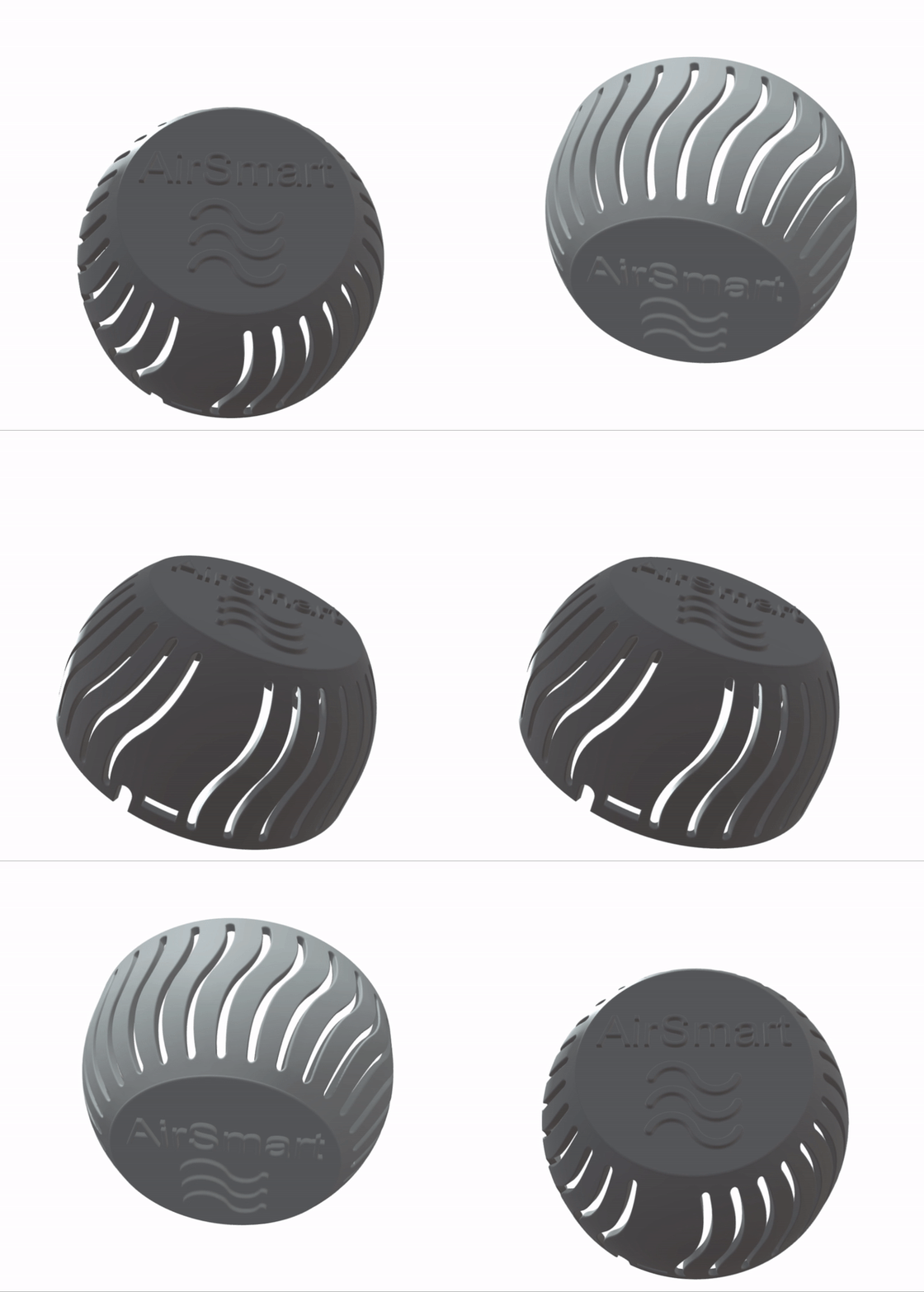
Airsmart - Distributed Congestion Monitoring System
University, Year 3, Group Project (Team of 4)
Conceptualised and developed a distributed system for congestion monitoring of indoor spaces.
This project brought together many engineering skills.
Among others, it involved:
-
conceptualising a commercial product
-
materialising an idea
-
creating a user friendly front-end design with 'Swift'
-
creating a backend
-
prototyping the nodes/devices using 'Raspberry Pis'.
-
creating complex algorithms for interpolation and triangulation with imprecise data
-
creating and training Neural networks and LSTMs to solve complex problems
+
Hover over the boxes below for more info
Loud Noise Detection

Each device/node in the monitoring network, communicates loud noise events to other nodes and the backend and initiates a real-time triangulation algorithm running on the backend.
Displaying Collected Statistics

AirSmart automatically creates statistics for the busiest days and hours for a space. This can be viewed intuitively from the app of any visitor.
Congestion Heatmaps

Congestion data from each node is interpolated by considering the distance of each point in a space to each sensor.
ML Cough Detection

If the noise level exceeds a certain threshold for any of the nodes/devices, the recorded 'noise event' is sent to the backend. A custom LSTM model, trained on the Open Source 'COUGHVID' dataset is used to distinguish coughs from other sounds.
Easy to use App

The mobile app is easy to use. Visitors of a space can just scan the QR at the entrance of the space and instantly see any information.
Neural Network Weighing of Sensor Readings

Each device/node features multiple sensors whose output is weighed using a custom Neural Network to give an estimated congestion value for that sensor.
Easy system setup

Developed an intuitive, easy to set up system. The system administrator simply scans the QR code at the bottom of each device/node to position it in the space.
General Purpose CPU Design
University, Year 2, Group Project (Team of 3)
Designed, optimised and benchmarked a general purpose Harvard architecture CPU with the aim of getting good performance for specific tasks (Fibonacci calculation and Linear Congruential Generator Algorithm).
-
+

Hover over the boxes below for more info
Performance Improvement Techniques

The CPU design makes use of various techniques to improve performance.
Some of these are:
-
Pipelining
-
Superscalar-like parallel execution of Jump instructions
-
etc.
Stack Implementation

Stack memory is implemented in the CPU design to enable recursion. This is designed for use in the execution of a Fibonacci algorithm.
Multiplication

A multiply and add (MAD) instruction was implemented for the Linear Congruential Generator. The multiplication is performed using a Wallace-Tree derived design.
PROFESSIONAL EXPERIENCE
Machine Learning Engineer
Just Eat Takeaway.com
Bristol, UK
Supporting the delivery of Machine Learning models into a production environment supporting JET customer's experience.
Working to drive automation solutions and design CI/CD pipelines to improve efficiency.
Starting Sep 2023

Hardware Engineering Intern
Arm
Cambridge, UK
I work in the Partner Enablement team, which is responsible for enabling Arm partners to effectively use Arm's IP.
I have created two internal tools for helping Arm Application Engineers with the support process.
Tools created:
-
Test-bench generator for debugging partners designs using the Arm NI-700 interconnect
-
Performance modelling tool for the Arm MMU-700 memory management unit
Technical Skills used/developed:
-
Python scripting
-
Shell scripting
-
System Verilog Digital Hardware Design
-
Performance Modelling
Mar 2021 - Feb 2023

Engineering Intern
EnGIS Technologies, Inc
Seoul, South Korea
I researched ADASIS v2 (Advanced Driver Assistance Systems Interface Specifications), gaining insight into standards and protocols, as well as into communication inside a car’s network, to support the business team in answering technical requests for information (RFI) from prospective clients.
Technical Skills used/developed:
-
Insight into protocols
-
Insight into Autonomous Driving Technologies
July - August 2018

Engineering Intern
LG Electronics
Seoul, South Korea
I worked on a Vehicle-to-Building (V2B) concept, which uses Electric Vehicle (EV) batteries, bi-directional energy transfer technologies and dynamic electricity pricing, in order to optimize the energy grid by stabilizing electricity demand.
Technical Skills used/developed:
-
Market Research
-
Developing a concept
July - August 2017

EDUCATION
Imperial College
Master’s in Electrical and Electronic Engineering
London
2019 - 2023
Geitonas School
International Baccalaureate/ Greek Education System
Athens, Greece
2008 - 2019
*excluding 2010
Chapel School
São Paulo, Brazil
2010
SKILLS
Python

Verilog HDL

Matlab

Java

PyTorch

C++

System Verilog

LT Spice

Socrates
(IP Configurator)

iOS App Development (Swift)

Git

Intel Quartus

Keras

Doulos Certified
Recent Relevant Modules


Artificial Intelligence


Machine Learning
.png)

Deep Learning

Languages
English

German

Greek

Portuguese

Hobbies
Mobile App Design

Mono-Ski

Tennis

Windsurfing

Wakeboarding

Running

Snowboarding

Skiing

Callisthenics